
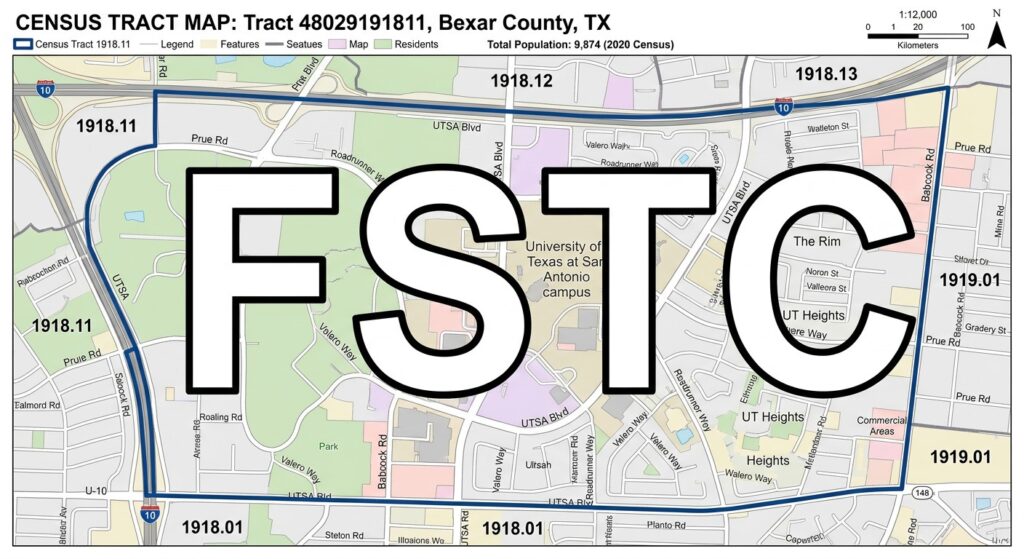
AI-generated image
By Jeff Wilson
One of the most fascinating aspects of Treasury’s new proposed FSTC rules is that not every family will have to prove their scholarship eligibility the same way. Instead, for some public-school students in need of scholarships for supports such as academic tutoring or special-needs services, where their school is located is set to become part of the eligibility process.
Under the upcoming Federal Scholarship Tax Credit, an eligible student is one that comes from a household whose total income is either equal to or less than 300% of the local area median gross income (AMGI), after adjusting for family size. In the vast majority of cases, the Scholarship Granting Organization, not the school or even the school district, is responsible for verifying an applicant’s eligibility before awarding the scholarship. This process is set to include options such as reviewing income documentation and/or relying on certain existing public-benefit determinations.
That being said, if an SGO plans on providing individual scholarships for academic tutoring, or for special-education services to students with special-needs, Treasury has said those students may be considered eligible under the incoming requirement without the usual income verification, provided a few different conditions are met. In particular, the student(s) must be identified by their school(s) based on their academic or special need. However, this only applies to schools that are either located in a qualified census tract, or that are able to attest that at least 80 percent of its students live in qualified areas.
Now, that doesn’t mean every student in a lower-income community automatically qualifies. These rules are very specific, and will likely only be applicable to a subset of the total tutoring and special-needs scholarships that an SGO will award. Nonetheless, this will remove a significant amount of income-verification paperwork for some of the most in need families.
For those of you who don’t know what a qualified census tract (QCT) is, the Department of Housing and Urban Development (HUD) annually publishes a list of areas where low-income families make up a significant portion of the population. In fact, HUD released the latest 2027 QCT designations only a few weeks ago, which was after Treasury released the proposed FSTC regulations. As such, and given that Treasury’s regulation only references the overall HUD’s QCT system as opposed to naming a specific annual list, we can safely assume that a 2027 HUD designation doesn’t automatically result in FSTC eligibility. But districts can and should review the QCT list now, in order to ask prospective SGOs about how they will approach this rule once the program begins in January.
In particular, the most important step I think that district leaders can take now would be to determine which, if any, of its schools are in areas that appear on HUD’s QCT maps. Once identified, school leaders in those QCTs should use this academic year to evaluate the tutoring and special-needs services their students currently use, so they are able to be effective collaborators when SGOs begin issuing awards in the fall of 2027. This is important because while the district doesn’t become responsible for determining household income, it will be responsible for selecting students based on individual need, and may need to certify where its students actually live, before scholarships can be awarded.
Beyond that, there is another income-verification detail that is worth understanding for the public school community. Namely, a schoolwide free- or reduced-price lunch designation does NOT automatically establish FSTC eligibility because the statute itself requires a household-level determination. Under a separate proposed method, however, an SGO could rely on recent documentation showing that the student’s household participates in federal assistance programs such as SNAP, TANF, WIC, Section 8 housing, or SSI. That particular distinction is important because while the free and reduced lunch program helps school leaders know that they serve a high-poverty population, it doesn’t provide the specific household-level information that an SGO needs to verify individual student eligibility.
Based on the regulatory analysis that Treasury provided, there are approximately an additional 170,000 students who would be considered eligible under this provision. Beyond that, they suggest that this provision will also help reduce barriers to entry for a number of low-income families who are unlikely, or unable, to provide an SGO with enough relevant paperwork to establish scholarship eligibility independently. With the proper preparation and management, these provisions will be essential in ensuring that scholarships are awarded where they can have the largest impact, both economically and academically!
That’s why here at FundEDU, and over the course of this blog series, we keep coming back to a practical question: what can leaders learn now that will make the program easier for families later? For this regulation, there is something concrete for leaders to follow up on. In particular, taking a few minutes to review the census-tract map, understand which students and services this regulation may apply to, and be prepared to discuss those items with potential SGO partners before families begin applying.