Prepared for: Diane Acri
Prepared by: Fund EDU
Date: June 12, 2026
Re: Suggested improvements to the Educational Improvement Tax Credit (EITC) program and considerations for federal Federal Scholarship Tax Credit (FSTC) opt-in legislation
Purpose
Thank you for asking us to share what we see on the ground in the EITC program. Fund EDU works daily with Pennsylvania businesses, individual donors participating through Special Purpose Entities (SPEs), scholarship organizations, and schools. The recommendations below come from that day-to-day experience. They fall into two groups. The first group concerns a new interaction between Pennsylvania’s EITC program and the federal Federal Scholarship Tax Credit that takes effect January 1, 2027. Without action, that interaction could cost Pennsylvania pass-through business owners real money on their federal returns. The second group is a set of mechanical fixes to longstanding friction points in how EITC credits are awarded, used, and claimed. None of these recommendations expands or contracts the program’s size or scope. They are about making the existing program work better for the Pennsylvanians who use it.
Background: The Federal FSTC in One Paragraph
Beginning January 1, 2027, federal law (IRC Section 25F, enacted in 2025) gives individual taxpayers a dollar-for-dollar federal income tax credit of up to $1,700 for cash contributions to approved Scholarship Granting Organizations (SGOs). The program was explicitly modeled on Pennsylvania’s EITC. Participation requires each state to opt in by submitting a list of approved SGOs to the U.S. Treasury. Pennsylvania has not yet opted in. Critically, the federal statute contains a reduction rule: a taxpayer’s federal credit is reduced by any credit allowed on their state tax return for qualified contributions made by the taxpayer. How Pennsylvania’s statute is worded determines whether that reduction rule reaches Pennsylvania taxpayers, which is where Recommendations 1 through 3 come in.
Part One: Protecting Pennsylvania Taxpayers Under the Federal Program
Recommendation 1: Codify entity-level credit award language for SPEs
The ask. Amend Article XVII-F of the Tax Reform Code to add explicit award-and-allocation language for pass-through participation. The amendment should state, in substance: 1. An EITC credit is
awarded to the business firm or special purpose entity that applied for the credit and made the contribution. 2. The contribution is
made by that entity, not by its owners or members. 3. An owner or member of a pass-through entity does not receive an award of the credit. The owner receives an
allocation of a credit that was already awarded to the entity, reported through ordinary pass-through mechanics (the K-1). This is a short amendment, a few sentences of definitional language, and it can ride on any tax code vehicle. It changes no rates, caps, deadlines, or eligibility rules.
The problem it solves, with a concrete example. Consider a Pennsylvania business owner who participates in EITC through an SPE and, beginning in 2027, also wants the new federal credit: • Her SPE contributes $10,000 to a scholarship organization and is awarded a $9,000 state credit (90 percent, through the SPE). Her share of that credit reaches her personal Pennsylvania return through a K-1. • Separately, she personally donates $1,700 in cash to a federal SGO and claims the $1,700 federal FSTC credit. • The federal reduction rule says her federal credit must be reduced by state credits allowed on her return “for qualified contributions made by the taxpayer.” If federal regulators read her K-1 credit as a credit for a contribution she made, her federal credit is reduced to zero, because the state credit on her return exceeds $1,700. Whether the reduction applies turns on three questions, and Pennsylvania’s statute controls the first two: 1.
Did she make the contribution? Operationally, no. The entity applied for the credits, signed the agreement with the scholarship organization, and wired the money. But the statute does not currently say this anywhere. The amendment says it. 2.
Was the credit awarded to her? Again, operationally no. DCED awarded the credit to the SPE; she received an allocation of an award that already existed. The statute does not currently say this either. The amendment says it. 3.
Was the EITC contribution a federal “qualified contribution” at all? It went to a state-designated scholarship organization, not a federal SGO, so under the federal definition it arguably never was. This third protection is the subject of Recommendation 3 below. Federal regulators interpreting the reduction rule will look to state law to determine who made the contribution and who was awarded the credit. Today, Pennsylvania law is silent on both points, and the answer rests on program practice and agency guidance. After this amendment, state law answers both questions directly and in the taxpayer’s favor. Only one of the three grounds above needs to hold for the reduction rule not to apply.
Why it matters. This change has zero fiscal cost to the Commonwealth; it changes wording, not money. What it protects is up to $1,700 per year in federal tax benefit for every Pennsylvania pass-through business owner who participates in both programs. This is a constituent-protection measure, not a school-choice measure.
Recommendation 2: Design principles for FSTC opt-in legislation
The ask. If and when Pennsylvania opts into the federal FSTC program (whether through HB 1763 or successor legislation), the opt-in statute should do two things: • (a) Make the SGO listing ministerial. The statute should direct the Commonwealth to list every organization that meets the federal Section 25F requirements: no discretionary selection, no state-favored organizations, and no single state-designated SGO. • (b) Decline to create any individual-level state tax credit for contributions to federal SGOs.
Plain-language explanation, part (a). Federal Treasury guidance issued to date indicates that states may not impose SGO requirements more restrictive than the federal statute itself. In other words, the state’s role in the listing process is administrative (verify that an organization meets the federal criteria and list it), not discretionary. Writing the opt-in statute this way has two benefits: it keeps Pennsylvania squarely inside the federal rules, avoiding a challenge that could disrupt the program for everyone, and it dramatically lowers the administrative burden on whichever agency runs the listing, because the agency is checking boxes rather than making judgment calls. A structure where the state hand-picks one or a few favored SGOs is both legally vulnerable under the federal statute and an administrative headache.
Plain-language explanation, part (b). This one is counterintuitive, so it deserves a careful walk-through. A legislator’s natural instinct when a new federal program arrives is to “sweeten” it with a matching state incentive, such as a Pennsylvania credit for individuals who donate to SGOs.
For this program, that instinct backfires. The federal statute’s reduction rule subtracts any state credit from the federal credit, dollar for dollar. So if Pennsylvania offered individuals a $500 state credit for an SGO donation, the donor’s federal credit would shrink from $1,700 to $1,200. The donor ends up exactly where they started, but now $500 of the benefit is being paid by Pennsylvania’s treasury instead of the federal government’s. The state would be spending its own money to displace federal money, with zero added benefit to the donor or to students. The right design is the opposite: let the federal government fund the individual-donor side at 100 cents on the dollar, and keep Pennsylvania’s dollars where they already work, in the existing business-side EITC program, which the federal program does not touch.
Why it matters. Pennsylvania’s existing EITC infrastructure (its scholarship organizations, schools, and administrative processes) was the explicit model for the federal program. A well-designed opt-in lets the Commonwealth capture the new federal funding stream for Pennsylvania students at essentially no state cost. A poorly designed opt-in either invites federal legal conflict (part a) or wastes state money (part b).
Recommendation 3: Address the dual-registration question
The ask. Direct DCED to maintain clearly separate designations for state EITC Scholarship Organizations and federal Section 25F SGOs, and formally request clarification from the U.S. Treasury on how the federal reduction rule applies when a single organization holds both designations.
Plain-language explanation. Recommendations 1 and 2 protect most Pennsylvania donors, but one scenario remains unresolved. When Pennsylvania opts in, many existing EITC scholarship organizations will also register as federal SGOs: the same nonprofit, wearing two hats. For a pass-through owner whose SPE donates to one of these dual-registered organizations, the third protective argument from Recommendation 1 weakens. Today, a strong reason the federal reduction rule should not apply is that EITC donations go to state-designated scholarship organizations, not federal SGOs, so the donation is not a “qualified contribution” under the federal definition at all. Once the same organization holds both designations, that line blurs. The state cannot fix this by itself, because the definitions live in federal law. But the state can do two useful things. First, keep the two designations administratively distinct (separate registrations, separate tracking, separate receipting), which preserves a clean factual record showing which program each contribution belongs to. Second, put the question to Treasury formally. A clarification request from a state government carries far more weight than one from a private operator, and Treasury is actively writing the implementing regulations right now, which means this is the window in which Pennsylvania’s input can actually shape the answer.
Why it matters. Without clarity, every pass-through EITC participant who also wants to claim the federal credit faces uncertainty their accountant cannot resolve. Uncertainty suppresses participation in both programs.
How Recommendations 1 Through 3 Work Together
These three items are one package addressing one problem: making sure a Pennsylvanian’s state EITC credit never erases their federal FSTC credit. There are three independent legal grounds on which the federal reduction rule should not reach EITC pass-through credits, and only one needs to hold:
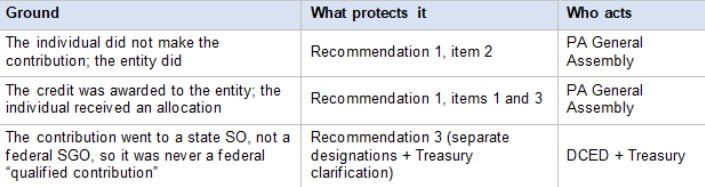
Recommendation 2 then ensures the opt-in legislation does not create a new version of the same problem by attaching a state credit to federal SGO donations.
Part Two: Mechanical Improvements to the EITC Program
Recommendation 4: Permanent carryforward for unused credits
The ask. Amend the EITC and OSTC statutes to allow unused credits to be carried forward for two to three years, at both the entity level and the pass-through-owner level.
Plain-language explanation. Today, EITC credits are use-it-or-lose-it. If a business or an SPE member’s tax liability comes in lower than expected (a down year, an unexpected deduction, a change in circumstances), any credit they cannot use that year simply evaporates. It cannot be carried to next year and cannot be transferred to anyone else. A temporary two-year carryforward existed for credits awarded in fiscal years 2020-21 and 2021-22, but it applied only at the entity level (individual owners receiving pass-through credits got no carryforward at all) and it has expired. This design forces donors to commit a year in advance to a contribution sized against a tax liability they can only estimate. Guess high, and money is lost. The rational response is to guess low, which means donors systematically contribute less than they otherwise would, and scholarship organizations receive less than the program’s cap would support. The new federal FSTC, by contrast, allows unused credits to carry forward five years. Pennsylvania, the state whose program was the national model, now has the more punitive design.
Why it matters. A carryforward removes the single biggest deterrent to fuller participation, particularly for individuals participating through SPEs, whose personal tax liabilities are the hardest to predict. The fiscal impact is modest and largely a matter of timing: these are credits the Commonwealth already awarded under the existing cap. Carryforward changes
when they are claimed, not
whether the program grows.
Recommendation 5: Fix the day-one application crush
The ask. Replace or supplement the current first-come, first-served allocation with one or more of the following: (a) proration across all applicants who apply on the opening day, rather than a random lottery among them; (b) a standing waitlist with automatic rolling award of any credits that are returned or go unused during the year; (c) authority for DCED to reallocate credits between undersubscribed and oversubscribed categories during the fiscal year.
Plain-language explanation. Here is how a Pennsylvania business experiences the EITC application process today: new applicants may apply beginning July 1. Applications are processed first-come, first-served by day, and all applications received on the same day are processed in random order. In practice, demand so far exceeds the cap that
credits are typically exhausted on day one. A business that applies July 2, or whose July 1 application loses the within-day lottery, gets nothing and must wait an entire year to try again. Meanwhile, two pools of value leak out of the program every year. First, some awarded credits are returned or never used (a business’s circumstances change, a contribution does not fund). Under current practice, there is no systematic mechanism to promptly re-award those credits to the businesses that were turned away. Second, the program’s categories do not fill evenly. Historically, OSTC credits have gone undersubscribed in years when EITC scholarship credits vanished on day one, yet credits generally cannot move between categories to meet actual demand.
Why it matters. Every credit that lapses unused while a waitlist of willing donors exists is scholarship money that simply never happened, at no savings to the Commonwealth, since the credit was already budgeted. We would respectfully suggest, as a first step, that your office request DCED data on returned and unclaimed credits by category for the past several fiscal years. If the lapsed amounts are material, and we believe they are, automatic reallocation is the rare reform that increases scholarships without increasing the cap by a single dollar.
Recommendation 6: DCED-to-Revenue data sharing for pass-through credit claims
The ask. Require (or fund) electronic transmission of EITC/OSTC award records from DCED to the Department of Revenue, so that pass-through credits pre-populate in myPATH and on taxpayers’ restricted-credit records, rather than being manually reconciled from paper documentation at filing time.
Plain-language explanation. Claiming a pass-through EITC credit on a personal return has become genuinely difficult for ordinary taxpayers. The 2025 redesign of PA Schedule OC replaced the old form’s pre-printed, named credit lines with a generic table requiring seven fields per credit, including an Award Number and Award Date that appear only on the original DCED certification letter,
not on the RK-1 the taxpayer actually receives from their SPE or business. Many self-filers have never seen that certification letter; it was sent to the entity, not to them. At the same time, the Department of Revenue’s new processing system has caused delays in recording credit pass-throughs, leading to confused taxpayers, follow-up calls, and notices, much of which lands on scholarship organizations’ phone lines, since they are the most visible party in the chain. The root cause is simple: DCED knows exactly which entity was awarded which credit, in what amount, on what date, under what award number, and the Department of Revenue is asking taxpayers to re-key that same information by hand from documents they may not have. Connecting the two agencies’ records eliminates the friction at the source. The award data would flow to Revenue when credits are awarded; pass-through allocations would match against entity filings; and the individual taxpayer’s myPATH account would already reflect the credit when they sit down to file.
Why it matters. This is a pure administrative-modernization measure: no fiscal cost beyond implementation, no winners and losers, fewer errors, fewer amended returns, fewer calls into the Department of Revenue. It also matters for the program’s reputation. For many individual SPE participants, the filing experience
is their experience of the program, and right now it is the worst part.
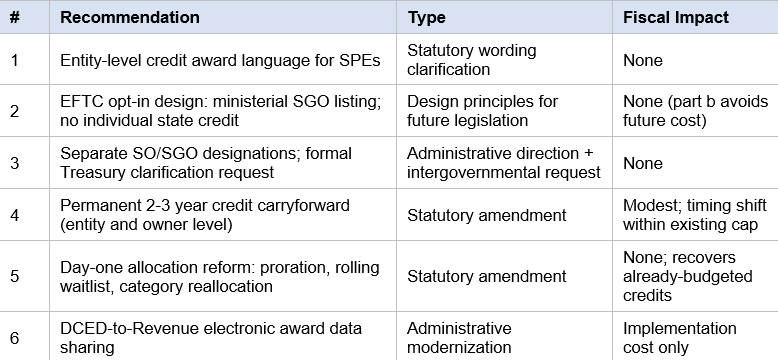
Summary Table
A Note on Scope
These recommendations reflect operational observations from our work with EITC participants. They are offered as policy input, not legal or tax advice. We would welcome the opportunity to walk through any of these items with you or your staff in more detail, to connect your office with the scholarship organizations and CPAs who see these issues daily, or to assist in reviewing draft language.
Contact: Jeff Wilson Owner, FundEDU LLC
jeff@fundedu.org (814) 283-4338