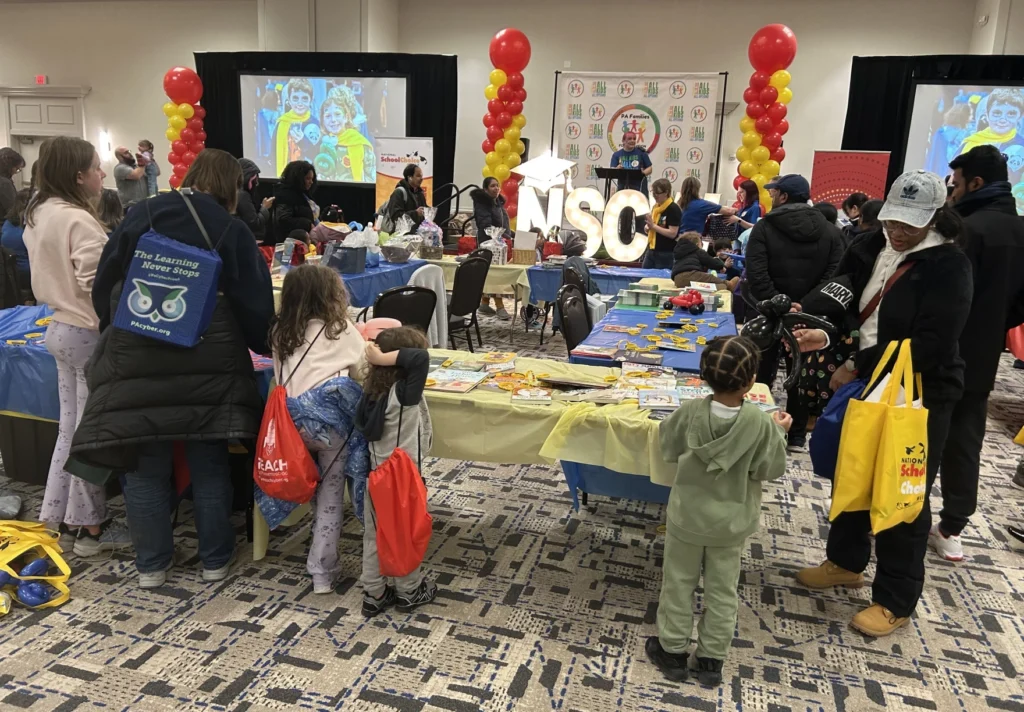
Over the weekend, Nicole Stitt attended the National School Choice Week Expo on Pittsburgh’s South Side, looking for a school she hopes will better suit her daughter’s learning style. “Traditional schooling just hasn't worked well for us,” Stitt said, whose daughter has ADHD. “She's currently in cyber school, which has its ups and downs.” Stitt’s daughter previously attended Plum Borough School District, northeast of Pittsburgh. Sitting still during long class periods, however, was challenging, and Stitt’s daughter was bullied. Now in seventh grade at PA Cyber, a virtual charter school, she can move around at home during the school day. But working independently and online at home while Stitt works full-time also has its drawbacks. “We're just looking for something that's less traditional, more hands-on kind of learning,” she explained. The Pittsburgh expo comes as federal education officials with the Trump administration have led a push to expand policies that funnel taxpayer dollars to options other than traditional public schools — namely charter schools, home schools, private schools and religious institutions. In October, U.S. Sen. Dave McCormick (R-Pa.) stood alongside school choice advocates to promote a new federal tax credit that would fund scholarships families can use at the school of their choice, including private and religious schools. It’s a model similar to the state’s existing Educational Improvement Tax Credit (EITC), which incentivizes business owners to donate to schools and education nonprofits. While Gov. Josh Shapiro has yet to announce whether Pennsylvania will opt into the program, many of those tabling at the expo on Saturday were hopeful he would. Online charter schools and private religious options made up a majority of the vendors present. “My firm belief is competition is good,” said Michael Freker with the Catholic Diocese of Pittsburgh. “Allow competition to exist and allow families to choose what's the best choice for their child, and public schools will thrive, charter schools will thrive, and private schools will thrive because they're going to help families.” The diocese announced Tuesday that it received a multi-million dollar investment from an anonymous donor through the state’s school choice tax credit program that will “make financial assistance available to everyone.” Taxpayers in the commonwealth claimed $500 million in Educational Improvement Tax Credits and $85 million in Educational Opportunity Scholarship Tax Credits during the 2024-2025 fiscal year, according to a December 2025 report from the state’s Independent Fiscal Office. The agency forecasts the programs will grow by another $95 million this year. But the governor’s budget proposal, released Tuesday, includes some indication of changes to the Education Improvement Tax Credit. Although left vague, the budget brief includes language about a proposal to “reallocate the caps within the program to provide more tax credits to Education Improvement Organizations.” The cap for the overall program remains unchanged. Only two states — Ohio and Florida, where tax-credit scholarships are not income-limited — have awarded more funds to families, Stephen Bloom, vice president at the conservative Commonwealth Foundation, recently wrote in a LancasterOnline op-ed. But while affordability was a top concern among the families WESA spoke to at the expo, religious education was not. Parents instead spoke of searching for more extracurricular options, better special education support and a stable place for their student to enroll if hotly-debated school closures at Pittsburgh Public Schools come to pass. The latter was a priority for Sabiha Mekhnache, whose soon-to-be kindergartener attends the district’s Spring Garden Early Childhood Center on the North Side. Mekhnache’s family is zoned for Spring Hill K-5, one of nine buildings slated for closure under the latest iteration of PPS’ reconfiguration plan. “I don't wanna register my son for the coming year and they're going to close it and [I will have] to find another school for him,” Mekhnache said. Jordan Davis, another North Side parent, attended PPS’ magnet school fair earlier last month. Davis said he’s considering all options to find the best fit for his four-year-old daughter as she prepares to start school. “I feel like it's a collaboration between the kid, the student, and your neighborhood,” he said. “And like I said, not always is it the best fit for the school in your neighborhood. Sometimes it is, sometimes it isn't.”
How much tax credit revenue is your school leaving on the table?
Book a free 20-minute Scholarship Revenue Review. We'll map your school's EITC opportunity - and your 2027 federal FSTC upside - with real numbers, before you spend a dollar.
How much tax-credit revenue is your school leaving on the table?
Book a free 20-minute Scholarship Revenue Review. We'll map your school's EITC opportunity, plus your 2027 federal FSTC upside, with real numbers, before you spend a dollar.